The work around the work
Preparing meetings. Gathering updates. Rewriting notes. Following up on actions. Necessary work that can crowd out the coaching and conversations your team needs.
AI Powered Scrum Master
A practical guide to using AI for better Scrum workflows—and more time for coaching, collaboration and human leadership.
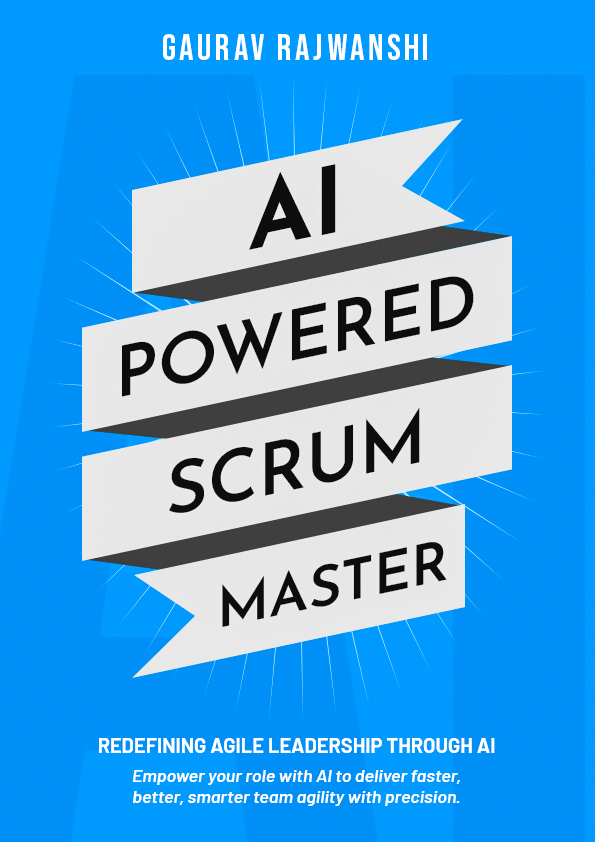
Redefining Agile Leadership Through AI
You became a Scrum Master to help people do better work. Yet so much of the week can disappear into the work around it.
Preparing meetings. Gathering updates. Rewriting notes. Following up on actions. Necessary work that can crowd out the coaching and conversations your team needs.
A story is still unclear. A blocker keeps returning. The retrospective ends with familiar themes. You have information, but turning it into a useful next step takes time.
Another AI tool. Another bold prediction about your role. You want a practical place to start, and a way to judge what is useful for your team.
That is the starting point of AI Powered Scrum Master.
THE IDEA BEHIND THE BOOK
AI can help you prepare, organise and explore. Your judgment gives that work meaning.
This book looks at the everyday practice of Scrum through that lens: how to use AI to make sense of information, ask better questions and reduce repetitive effort, while staying close to the people doing the work.
You will move from understanding AI to applying it in backlogs, planning, daily conversations, reviews and retrospectives. Along the way, you will explore adoption, team trust, data quality and the decisions that need a human hand.
Explore the full book on AmazonWHAT YOU WILL EXPLORE
Practical ways to bring AI into the moments that shape your team's work.
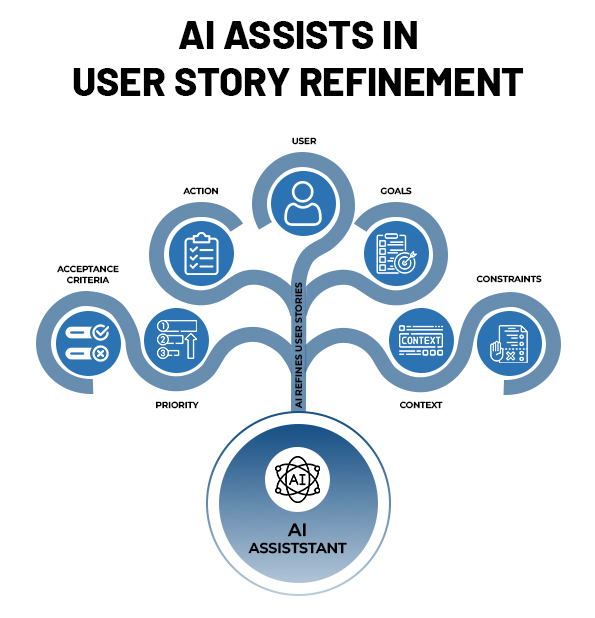
Use AI to explore context, expose assumptions and sharpen acceptance criteria. Learn how a clearer prompt can support a more useful refinement conversation.
User stories · Backlog refinement · Chapters 5, 9 & 10
Explore capacity, dependencies and historical information with AI support. Bring possible blind spots into the discussion before the team commits to its plan.
Capacity · Sprint planning · Chapters 10 & 11
Turn scattered updates into a clearer picture of progress. Look for recurring blockers and create more room for the team to coordinate its next steps.
Daily Scrum · Workflow support · Chapter 12
Explore different retrospective formats, group feedback into themes and prepare better questions. Keep interpretation and improvement decisions with the team.
Reviews · Feedback · Retrospectives · Chapter 13
Understand how assistants, chatbots and agents can support notes, summaries and routine coordination. Consider the fit, limitations and oversight each use requires.
Chatbots · Agents · Meeting assistants · Chapters 14, 15 & 18
Think through trust, empathy, responsible adoption and the quality of your data. Develop a deliberate approach to where AI contributes and where your judgment leads.
Human judgment · Adoption · Chapters 6, 16 & 19
THE THINKING BEHIND THE TOOLS
Three ideas from the book to guide the decisions behind the tools.
01 / THE PICK MODEL · CHAPTER 1
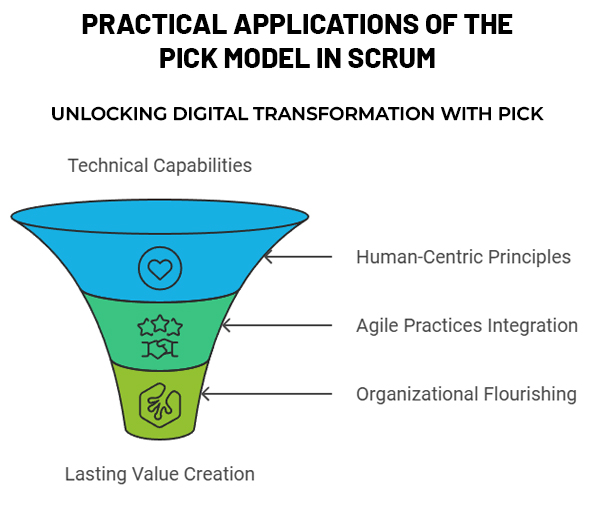
Buying a tool is a beginning. Making it useful depends on the people around it, the systems beneath it, the culture it enters and the knowledge that grows with it.
PICK brings those four elements into one conversation. Select an element to explore a question you can take back to your team.
Concerns about confidence, relevance or job security can shape adoption. The book explores communication, involvement and hands-on learning as part of helping people move forward.
Ask your team: “What would help you feel confident trying AI in one part of our work?”
Tools, access, connected systems and dependable information influence what your team can actually use. The book connects these foundations to the practical needs of Agile delivery.
Ask your team: “What is missing from our tools or data that would make a useful experiment difficult?”
A culture of collaboration and experimentation helps people share what works and what fails. AI adoption benefits from the same inspection and adaptation that already sit at the heart of Scrum.
Ask your team: “Can we question an AI suggestion and share an unsuccessful experiment without blame?”
Useful learning should travel beyond the person who found it. The book considers the information, skills and shared knowledge needed to keep improving as technology changes.
Ask your team: “How will we capture what we learn so the next person starts further ahead?”
A short introduction to PICK. The book develops the model and its practical application in Scrum.
02 / THE AI–HUMAN COLLABORATION METRIC · CHAPTER 6
Look at a workflow you know well. How much of your energy goes into processing information, and how much goes into the judgment and conversations that follow?
MANUAL WORK
You gather, sort and summarise information yourself. Much of your attention goes into getting ready for the conversation.
AI-SUPPORTED WORK
You use AI for a summary, a first draft or a set of questions, then check and adapt the result to your situation.
HUMAN–AI PARTNERSHIP
AI support becomes a considered part of the workflow. You keep responsibility for context, relationships and decisions.
Presented in the book as a way to think about collaboration across a spectrum; this preview does not assign a numerical score.
The useful question: where could AI create more space for your human contribution?
03 / THE AI ADOPTION DECISION MODEL · CHAPTER 16
Consider the business value of a task alongside the risk of getting it wrong. A routine summary and a high-stakes product decision deserve different levels of human oversight.
The book uses these two dimensions to help teams discuss the role AI should play. The conversation matters as much as the quadrant.
Explore the thinking in the bookMinimal AI use.
Close supervision.
AI contributes insight.
People decide.
Explore reducing
repetitive effort.
Use AI support.
Review the outcome.
WHO THIS BOOK IS FOR
You do not need to be an AI engineer to explore these ideas. A curiosity about better ways of working is a useful starting point.
Connect AI to your daily practice, from preparing a refinement session to supporting continuous improvement.
Use the frameworks to explore adoption, build confidence and shape a more thoughtful conversation about AI.
Explore clearer stories, better preparation and ways to bring more useful information into team decisions.
Build a foundation before moving into practical examples, prompting techniques and more advanced applications.
TRY AN IDEA BEFORE YOU BUY
Try this before your next backlog refinement. Start with a fictional or anonymised story and ask AI to identify the questions worth discussing.
The value is in what you do next: check the suggestions, bring them to the team and use them to improve your shared understanding.
A starter prompt adapted for this page from the book's approach to user story development.
Act as a thinking partner for backlog refinement.

Review this user story for clarity. Identify missing context, assumptions and ambiguous acceptance criteria.

Ask clarifying questions before suggesting a rewrite. Do not invent requirements. Separate what the story states from what you are assuming.

User story: [insert a fictional or anonymised story]
Review the output with your team. Use only information you are authorised to share with your chosen AI tool.
Explore the examples, reflection questions and exercises behind the ideas.
A LOOK INSIDE THE IDEAS
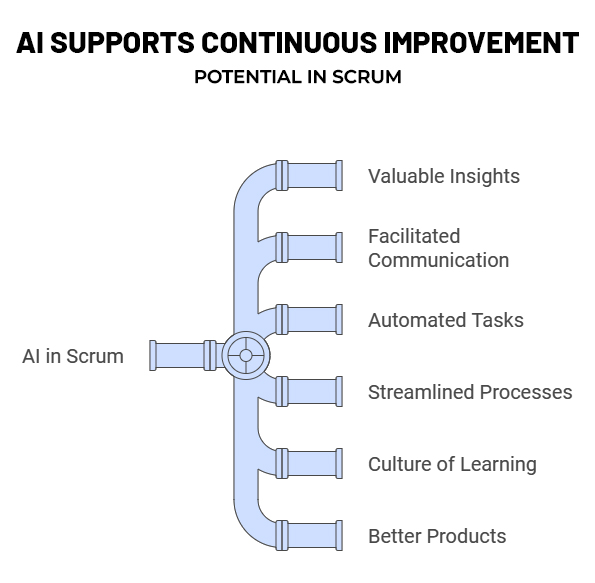
A few of the accompanying infographics show how the book connects AI capabilities to the everyday work of a Scrum Master.
INSIDE THE BOOK
Read from the foundations through to advanced applications, or return to the chapter that speaks to the challenge in front of you.
Explore the shift from tools to digital coworkers and the four elements of PICK.
Connect AI to Scrum roles, continuous improvement and the human element.
Consider where AI can contribute to decisions and team working.
Build a foundation in AI concepts and their practical applications.
Explore user stories, Jira and the wider effects of AI on Scrum workflows.
Look at collaboration, adoption and the AI–Human Collaboration Metric.
Understand generative AI, prompting and the possibilities these tools introduce.
Explore different prompting styles and the ingredients of a useful prompt.
Connect prompting techniques to situations in Scrum practice.
Explore how AI can support the organisation and refinement of backlog items.
Consider capacity, historical information and the need to validate recommendations.
Explore summaries, recurring blockers and the way teams share progress.
Prepare reviews, explore retrospective ideas and consider inclusive feedback.
Look at team knowledge, chatbot use and the considerations around implementation.
Explore agents and their potential role in supporting connected workflows.
Examine judgment, data quality and the value/risk model for AI adoption.
Develop and adapt prompts to the context of your Agile work.
Explore transcription, summaries and practical integration considerations.
Reflect on adoption challenges, responsible use and future possibilities.
Also includes an introduction, conclusion, glossary, reflection questions and practical exercises. Chapter descriptions are brief summaries.
See the book and available editions on AmazonPUT YOUR READING TO WORK
You do not need to redesign your team's entire way of working. Use this simple reading approach to turn an idea into a conversation, then an experiment.
Pick something specific: unclear acceptance criteria, time spent preparing notes, or feedback that is difficult to organise. Name the problem before choosing the tool.
Find the relevant chapter. Adapt a prompt or exercise to your context, agree the boundaries with your team and decide what a useful result would look like.
Did the experiment improve clarity, reduce effort or create a better discussion? Keep what helped, adjust what did not and share the learning with your team.
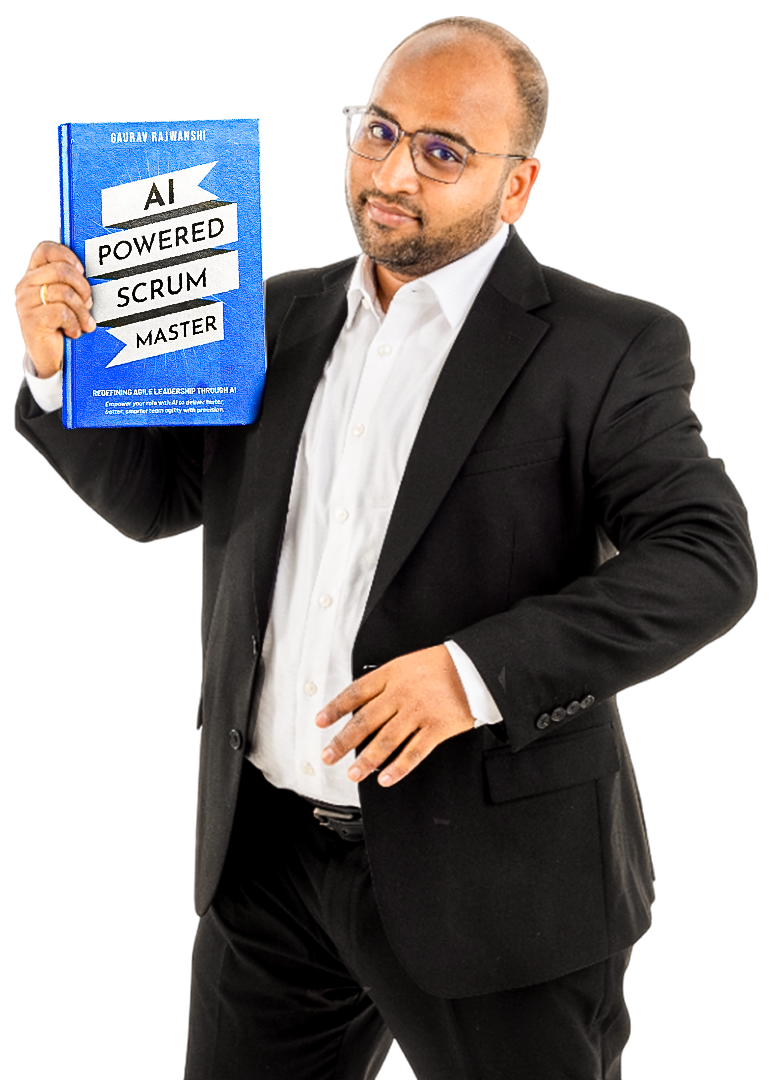
A NOTE FROM THE AUTHOR
My journey has taken me from developer and engineer to Scrum Master, coach, consultant and transformation leader. Along the way, I have seen how much time capable people spend on administrative work that pulls them away from helping their teams.
I wrote AI Powered Scrum Master in 2024 as my first book, to help practitioners explore what AI could make possible in their everyday work.
The heart of the book is a practical question: how can we use these capabilities to create more space for judgment, empathy, coaching and meaningful collaboration?
“AI is here to augment the art and science of servant leadership.”From the preface of AI Powered Scrum MasterMore about Gaurav
BEFORE YOU TURN THE FIRST PAGE
Everything you need to decide whether this book is right for you.
Ask Gaurav a questionThe book begins with AI foundations before moving into practical Scrum applications. It is written for practitioners exploring how to use AI in their work; you do not need to build an AI model to engage with the core ideas.
Scrum Masters are the primary audience. Agile coaches, delivery managers, Product Owners and team leaders may also find the workflows and adoption frameworks useful, particularly if their role involves collaboration and continuous improvement.
Prompts are part of the practical material. The book also explores the PICK model, the balance between AI and human contributions, and business value and risk in adoption decisions. These give you a way to think about which tools and techniques fit your context.
Specific products, interfaces and features change. Read the tool examples in their 2024 context and check current capabilities before using them. The book's broader focus on clear questions, human judgment, team learning and thoughtful adoption can help you evaluate newer tools too.
Yes. The manuscript includes prompt examples, reflection questions and exercises across the chapters, alongside discussions of how AI can support Scrum workflows.
Buy through the Amazon listing. Amazon displays the current price, available formats, delivery options and availability for your location.
No. Every “Buy on Amazon” link takes you straight to Amazon in a new tab. You can check the details there and complete your purchase through your Amazon account.
You can read customer reviews on Amazon. For a team reading group, start with a shared challenge and use the chapter reflection questions to guide your discussion. For enquiries, contact Gaurav.
AI POWERED SCRUM MASTER
Explore the ideas. Try one useful change.
Make more room for the people you lead.
Current price, formats and delivery details are shown on Amazon.